✓
Trusted by 40% of Fortune 1000


The Fed’s Global Supply Chain Pressure Index (GSCPI) tracks how sharply global supply chain pressures shift over time, and few signals matter as much as a supplier’s financial health. That’s why, before a new supplier is approved, financial health is the risk category that deserves the first look. A financially distressed supplier rarely fails in just one way. Quality assurance slips as cost-cutting reaches the production line, R&D investment dries up, logistics experience upsets, and capacity shrinks just when a company needs it most. Push far enough, it’s not if a supplier goes bankrupt but when, taking supply continuity down with it.
Financial analysis should happen upstream, during supplier discovery: pull the full list of vendors with the required capability and review each one’s Risk Level based on scores/ratings (or payment performance). If more than three suppliers are viable, eliminate the high-risk vendors outright and focus on inspections and specification requirements. Financial standing should still factor into the final bid decision, and once high-risk suppliers are screened out early, the remaining work is monitoring for deterioration to catch warning signs before they escalate.
That’s why financial risk assessment belongs at the front of sourcing and why it needs to stay in place as continuous monitoring long after the contract is signed. This article covers how real-time financial monitoring puts that priority into practice, from how to prioritize supply chain risk to the KPIs worth tracking.
Here’s What We’ll Cover
- What Is Supplier Risk Management, and Why Is Financial Risk So Important?
- How to Prioritize Supply Chain Risk
- How Real-Time Financial Monitoring Improves Supplier Risk Management
- What Is Business Impact: Cost, Continuity, and Compliance
- How to Build a Supplier Risk Management Program
- Final Thoughts
What Is Supplier Risk Management, and Why Is Financial Risk So Important?
Supplier risk management is the ongoing practice of identifying, assessing, and monitoring the risks a supplier could introduce to a company’s operations, spanning financial, operational, compliance, geopolitical, and environmental exposure across the network. It already sits on most procurement and supply chain agendas. Alongside all risk categories, financial risk should be continuously monitored – for example, a supplier may not be financially stable when they were sourced or onboarded.
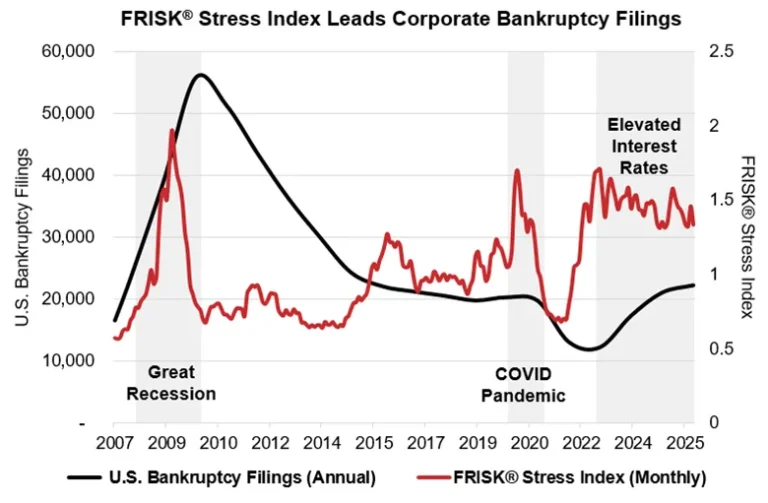
That sequencing matters because financial health is a leading indicator of supply disruptions. A supplier’s financial health typically deteriorates before its delivery performance does and before compliance issues surface. Financial risk assessment, done at sourcing and sustained through continuous monitoring, is what turns supplier risk management from a static compliance exercise into an early warning system. Vendor risk management and third-party risk assessments touch similar ground, but supplier risk management is the broader discipline, and financial risk is what should clear or flag a supplier before the other categories are reviewed.
Organizations need visibility into their tier 1 suppliers and their N-tier suppliers alike. Understanding which suppliers are financially distressed helps a team identify issues sooner and prevent the major disruptions that follow when those warning signs go unnoticed, up to and including a supplier’s bankruptcy filing. The historic examples below show what’s at stake without that visibility:
| Company Bankruptcy (Year) | Supply Chain Impact |
| Hanjin Shipping (2016) | South Korea’s largest container carrier collapsed, stranding roughly $14 billion in cargo on ships that couldn’t dock and throwing global container shipping into chaos right before peak season. |
| Takata (2017) | The airbag maker’s bankruptcy followed the largest automotive recall in history, forcing automakers worldwide to scramble and requalify new suppliers. |
| Carillion (2018) | Britain’s second-largest construction and outsourcing firm collapsed, leaving around 30,000 suppliers financially exposed and roughly 450 public infrastructure projects in crisis. |
| Briggs & Stratton (2020) | The small-engine maker filed Chapter 11 during COVID, disrupting supply for lawn and garden equipment brands that depended on its engines. |
| Yellow Corporation (2023) | The largest trucking bankruptcy in U.S. history saw a top less-than-truckload (LTL) carrier with roughly 30,000 employees shut down almost overnight, forcing shippers to mass rebook freight and straining rival carriers’ capacity. |
| Unique Fabricating (2023) | An automotive interior parts supplier filed for bankruptcy months after GM, Stellantis, and Yanfeng, its three largest customers, put up an emergency bailout to try to keep parts flowing to their assembly lines. |
| First Brands Group (2025) | The owner of major aftermarket auto parts brands like FRAM, Raybestos, and Autolite collapsed with liabilities exceeding $10 billion, closing plants and winding down units, and pushing Ford and GM into direct financing talks to keep components flowing to their assembly lines. |
None of this makes supplier risk management a compliance checkbox. Supplier risk data feeds directly into risk assessments and risk levels, giving procurement and finance teams a shared picture of financial health. That picture should be the starting point for every other risk conversation a team has about a supplier, not an afterthought bolted onto contract renewal. Strong supplier relationships depend on it. When[1] both sides understand a supplier’s financial stability, conversations about pricing, capacity, and contingency planning are easier rather than adversarial.
How to Prioritize Supply Chain Risk
Prioritize supply chain risk in three tiers: financial risk first, total cost of ownership second, and other risk categories third. Financial, operational, compliance, geopolitical, cybersecurity, and climate risk all compete for the same limited sourcing team bandwidth, and without a clear order of priority, teams end up reacting to whichever risk made headlines most recently instead of the one most likely to predict trouble.
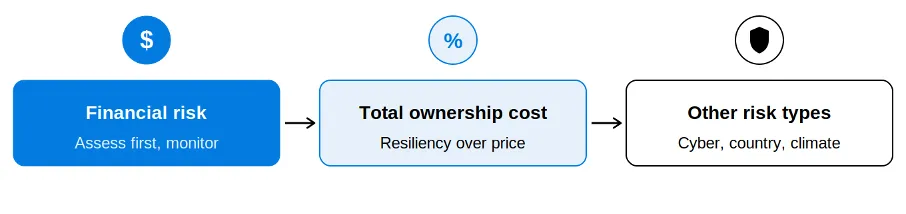
Priority One: Financial Risk. A financially distressed supplier rarely shows up on a scorecard first. Declining financial health tends to surface as profitability breaks, debt becomes untenable, or liquidity wanes before it shows up as quality fade, an R&D pullback, a missed shipment, or a bankruptcy filing that breaks supply continuity outright. Financial risk is the one to check first, both at sourcing and continuously after, since it tends to move earliest and cascade into the rest.
Priority Two: Total Cost of Ownership. The cheapest quote on a sourcing scorecard isn’t always the cheapest supplier in practice. A lower unit price that comes with inconsistent quality, longer lead times, or a higher risk of disruption ends up costing more once rework, expedited freight, and lost production time are factored in. Weighing total cost of ownership, with an emphasis on supply chain resiliency rather than sticker price, keeps a sourcing decision from trading a short-term discount for a long-term risk.
Priority Three: Other Risk Categories. Geopolitical exposure, cybersecurity incidents, weather, logistics, and other supply issues are all real and important. But if the supplier is failing or doesn’t pass the cost of ownership test, then it shouldn’t be a supplier in the first place. Stay ahead of these risk categories through real-time news alerts, entity sanctions screening, and country risk ratings to catch the loudest signals in these areas, layered on top of financial risk monitoring rather than in place of it.
How Real-Time Financial Monitoring Improves Supplier Risk Management
Real-time monitoring changes supplier risk management from a periodic exercise into a continuous process, and it works best with daily updated risk scores and news alerts. Here’s what that looks like in practice:
- From Periodic Reviews to Continuous Financial Monitoring. Real-time monitoring transforms supplier risk management into a predictive process, enabling proactive risk detection rather than relying on periodic assessments that only catch problems after they’ve occurred.
- Early Warning Signs of Financial Distress. Real-time financial monitoring can identify early warning signs such as declining supplier financial health long before a supplier upset. Deteriorating financials, a sudden shift in payment behavior, or other material risks tied to a supplier can show up in scores before it shows up in the supply chain, letting companies avoid emergency sourcing costs and production delays.
- Threshold-Based Alerts and Automated Escalation. Real-time monitoring allows immediate investigation when predefined thresholds are triggered. For example, a declining supplier risk score can result in a review the same day it occurs, reducing the need for manual financial reviews in supplier risk management.
- Comprehensive Supplier Profiles Built on Quality Data. Comprehensive supplier profiles can be created by combining financial and operational data into a single, continuously updated view, with financial standing as the anchor. This gives greater visibility across the supplier network.
- Better Prioritization and Decision-Making. Organizations can prioritize suppliers based on live financial data and emerging risks, segmenting suppliers by risk levels so risk management efforts land on critical suppliers first.
- Artificial Intelligence, Machine Learning, and Predictive Financial Risk Signals. Artificial intelligence requires a vetted, trusted source of underlying data to place guardrails into the process. AI can then improve supplier risk management through real-time financial data analysis at a scale manual review can’t match.
Business Impact: Cost, Continuity, and Compliance
- Fewer Supply Chain Disruptions. Supplier risk management, anchored in financial monitoring, helps prevent costly supply chain disruptions, protects business continuity, and ultimately protects revenue.
- Lower Emergency Sourcing Costs. Early insolvency signals remove the premium companies otherwise pay for last-minute replacement sourcing, turning a scramble into a planned transition.
- Reduced Manual Effort. Automated vendor risk assessment can save a considerable amount of time that would otherwise go into manual spreadsheet reviews, and automated financial risk assessments help teams prioritize suppliers that require review.
- Stronger Compliance Posture. Continuous financial monitoring supports compliance with third-party risk management (TPRM) requirements that regulators and auditors increasingly expect companies to demonstrate.
- Operational Efficiency and Competitive Advantage. Together, these gains compound into operational efficiency and a durable competitive advantage. Companies that put financial risk first spend less time reacting and more time growing, with risk control built into daily operations.
7 Steps to Building a Supplier Risk Management Program
Choose supplier risk management solutions that monitor financial risk continuously across large, complex supplier bases. When evaluating supplier risk management software or a vendor risk management platform, weigh data quality, business coverage, and accuracy.
Organizations also need supplier lists containing every supplier, its full address, spend dollars, and optionally relevant metadata such as criticality, direct or indirect classification, or commodity type, providing better context into its supply chain. From there, supply teams can create or enhance their approaches to sourcing and supplier monitoring:
- Track Supplier Risk Management KPIs. Time-to-detect on financial health changes, percent of spend monitored for financial risk, N-tier coverage, alert-to-action time, and supplier reliability all drive continuous improvement and raise risk awareness across procurement, finance, and operations teams. And finally, build these KPIs into your Vendor Scorecards.
- Assess Financial Risk First at Sourcing. Before considering any supplier, run a financial risk assessment. It’s the fastest, cheapest signal of whether a relationship is worth building.
- Source Private Company Financials to Close Visibility Gaps. Public suppliers file financial statements regularly, but most suppliers are private companies that never disclose financials on their own. Requesting statements directly, or using a data provider that can assess private companies through automated processes, gives transparency into private supplier financial health.
- Segment Suppliers and Define Risk Levels, Starting with Financial Standing. Map all your suppliers, identify critical suppliers, and assess by risk level (high, medium, and low).
- Set Financial Thresholds and Escalation Paths. Define who acts on each financial risk signal and how fast. Monitoring risks without clear ownership changes nothing, no matter how sophisticated the underlying supplier risk assessment is.
- Diversify and Plan for Contingency Informed by Financial Scores and Ratings. Diversifying the supplier base reduces dependence on a single supplier and builds supply chain resilience against shocks no monitoring system can fully prevent. Strong supplier relationships still matter here. The best contingency plans are built with backup vendors long before they’re needed, chosen because their financial risk profile is sound.
- Integrate Financial Risk Management Into Procurement. Supplier risk management should be integrated into procure-to-pay, sourcing, and other risk systems, not run alongside them as a separate, occasional exercise. That integration is what makes a resilient supply chain.
Final Thoughts
Real-time financial monitoring moves supplier risk management from reactive to predictive, helping organizations stay ahead of suppliers that could disrupt revenue and damage reputation.
That means tracking a supply chain every day, not once a quarter: financial risk as the anchor signal, with compliance, operational, cybersecurity, and climate risk layered in through real-time news alerts, entity sanctions screening, and country risk ratings. SupplyChainMonitor™ is built around that same order of priority. Best practices on supplier financial risk are also shared with the broader sourcing and procurement community through The Hackett Group and Sourcing Industry Group (SIG).
Teams still relying on periodic reviews are finding out about supplier problems later than they need to. Putting financial risk first and monitoring it continuously closes that gap.
Sources
- Federal Reserve Bank of New York, Global Supply Chain Pressure Index (GSCPI), a monthly measure of global supply chain conditions built from transportation and manufacturing data, independent of any single company or vendor.
- CreditRiskMonitor.com Recognized by Spend Matters Fall 2025 SolutionMap, covering SupplyChainMonitor’s rankings in Spend Matters’ independent analysis of supplier risk management and third-party risk management technology.
- SupplyChainMonitor™ vendor profile, listed in The Hackett Group’s Vendor Directory.
- CreditRiskMonitor sponsor profile, featuring SupplyChainMonitor™ on Sourcing Industry Group (SIG).