✓
Trusted by 40% of Fortune 1000


In our previous article, we explained how organizations and accounts receivable teams benefit from sharing trade receivables data. This follow-up focuses on what contributors receive in return: daily Receivables at Risk reporting and bankruptcy filing alerts matched to their own customer accounts.
When every customer account is monitored with a highly accurate bankruptcy risk model, a credit team can do two things at once: take action on high-risk accounts and extend more credit to medium- and low-risk accounts, supporting sales growth.
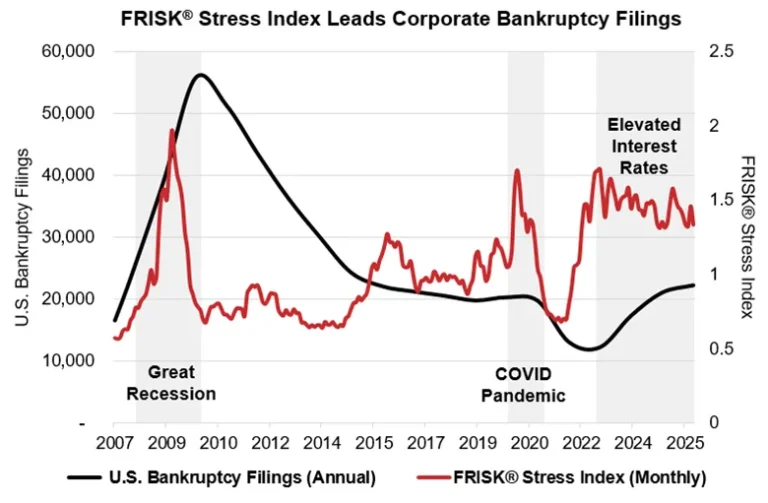
Current conditions make this discipline more urgent. U.S. bankruptcy filings for the trailing twelve months (TTM) ending in Q2 2026 were 33% higher than the 10-year average, driven by small and medium-sized private companies, where trade payment indicators really matter.
Here’s What We’ll Cover
- Share Your Trade Data: Reduce Write-Offs and Improve Collections
- How Can Credit Teams Identify and Act on Receivables at Risk?
- What Should Credit Teams Do When a Customer Files for Bankruptcy?
- Frequently Asked Questions
Share Your Trade Data: Reduce Write-Offs and Improve Collections
The Trade Contributor Program is CreditRiskMonitor’s trade data exchange. Participating companies submit their accounts receivable (A/R) trade file – the standardized record of how each customer pays – and receive risk insights drawn from a network $3 trillion in global payment data.
An internal system only reflects how a customer pays your organization. On the other hand, a trade program shows how the same customer pays its other suppliers, along with its probability of bankruptcy. Contributor identities remain anonymized and all insights are matched directly to your customer accounts, so findings translate into prioritized credit actions.
Two components of the program are central to managing that exposure: Receivables at Risk reporting and bankruptcy filing alerts.
How Can Credit Teams Identify and Act on Receivables at Risk?
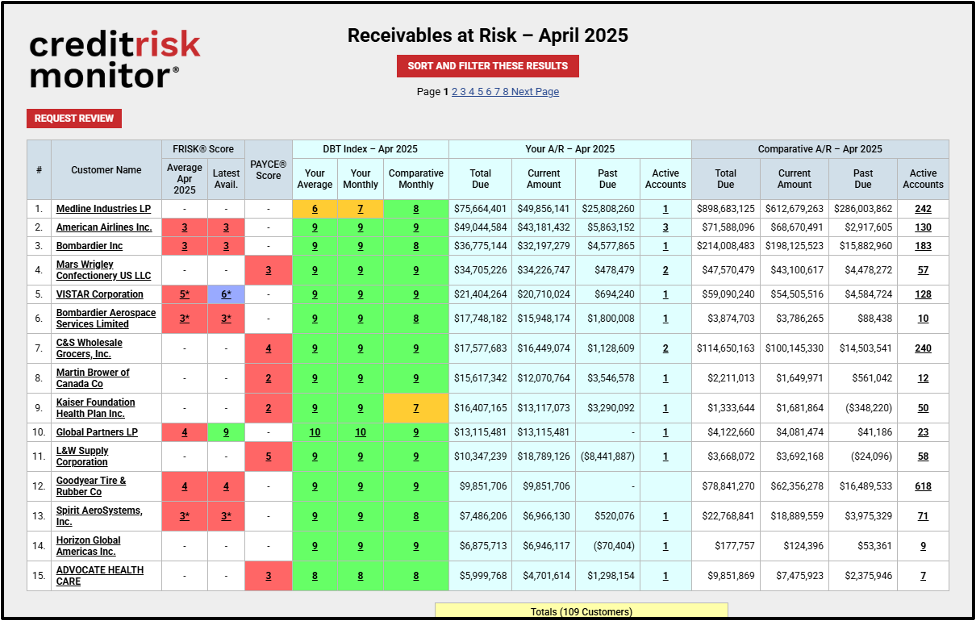
Credit teams identify high-risk A/R by monitoring every customer account with a predictive bankruptcy risk model, rather than relying on aging reports. CreditRiskMonitor’s Receivables at Risk reporting does this for Trade Contributor Program participants, delivering real-time scores on each of your accounts and showing how much of your monthly updated A/R balance is exposed to elevated bankruptcy risk.
Every report automatically includes CreditRiskMonitor’s AI-driven PAYCE® Score, which is 80% accurate in signaling private company bankruptcy. That accuracy matters because most private companies don’t publish financial statements, leaving aging reports and payment history as the main warning signs, which tend to lag deteriorating credit quality.
With risk visible across the portfolio, credit teams can apply a distinct policy to each risk tier:
- High-risk accounts: Tighten payment terms; request deposits, cash payments or guarantees; accelerate collection processes; and reduce credit limits before balances grow.
- Medium-risk accounts: Increase credit limits where warranted, subject to credit review, to support growth while exposure remains under analyst oversight.
- Low-risk accounts: Auto-approve orders and credit limit increases within established policy, accelerating sales and freeing credit analysts to focus on accounts that require judgment.
This approach reconciles two mandates credit departments carry simultaneously: protecting cash flow and supporting revenue growth. Because a relatively small cohort of high-risk accounts constitute a disproportionate share of write-offs, concentrating resources there allows the remainder of the portfolio to be managed for growth. In addition, in situations without a consolidated view of A/R across divisions or systems, a trade program helps roll up your A/R so your organization can see the total exposure on an account.
Often, these decisions run inside automated workflows. Through CreditRiskMonitor’s integration with most major systems with pre-built connectors, as well as our partnership with Nuvo and HighRadius, credit teams can configure those system to monitor PAYCE® Score changes and slowing payments across their portfolio. This includes applying CreditRiskMonitor risk data and credit limit guidance during onboarding, credit reviews, and collections workflows.
What Should Credit Teams Do When a Customer Files for Bankruptcy?
When a customer files for bankruptcy, credit teams should immediately stop all collection activity to comply with the automatic stay, freeze further credit exposure, protect its claim, and update its bad-debt reserves. Acting on the day of the filing requires knowing about the filing that day, which bankruptcy filing alerts provide.
Speed also creates opportunity, particularly in Chapter 11 reorganizations. In the first days of a case, the debtor typically asks the court for permission to pay vendors it considers critical to continued operations, and creditors that engage early are better positioned to be part of those discussions. The U.S. Trustee also forms the Official Committee of Unsecured Creditors early in the case, generally drawing from the largest unsecured creditors willing to serve. Committee members have a direct voice in shaping the restructuring plan, an influence that late-moving creditors forfeit.
The Trade Contributor Program’s bankruptcy filing alerts flag a filing as soon as a company files, matching it to your customer accounts. Rather than learning of a filing through a court notice or a missed payment weeks later, the credit team is informed on the day of the filing.
Timely notification carries greater weight in the current environment. With filings running 33% above the 10-year average, and smaller and medium-sized private companies driving the increase, a growing share of filings involve companies that receive little or no public coverage.
1. Compliance with the Automatic Stay
The moment a debtor files for bankruptcy, federal law puts an automatic stay into effect.
- Halt collection actions: Immediate notice lets the credit team stop all billing, collection calls, emails, and active lawsuits right away.
- Avoid legal penalties: Continuing collection efforts after a filing can result in court-ordered sanctions and financial penalties for violating the stay.
2. Immediate Risk Mitigation and Account Freezes
Early awareness lets the credit department lock down exposure before more debt accumulates.
- Cut off credit lines: Suspend or terminate open lines of credit and stop fulfilling open purchase orders. Credit teams can implement workflow automation to reduce the credit limit to $0 or block orders upon filing bankruptcy.
- Reclaim in-transit goods: In B2B sales, a seller may be able to exercise reclamation rights to stop or recover goods shipped shortly before the filing. These rights are time-sensitive, making prompt notification essential.
3. Preservation of Rights and Claims
Bankruptcy courts enforce strict timelines, and a missed deadline can eliminate a creditor’s opportunity for recovery.
- File a Proof of Claim: Early notice gives the team time to gather documentation and file a Proof of Claim on time.
- Attend the Meeting of Creditors: The credit manager or legal counsel can prepare for the 341 Meeting (Meeting of Creditors) and question the debtor if fraud or hidden assets are suspected.
4. Accurate Bad-Debt Reserves and Financial Forecasting
Immediate awareness also supports accurate financial reporting.
- Adjust financial records: Reclassify the outstanding balance as bad debt or move it to the allowance for doubtful accounts.
- Halt interest accrual: Stop accruing uncollectible interest so financial reporting stays accurate.
Each bankruptcy proceeding is distinct, and these steps should be taken in consultation with legal counsel.
Final Thoughts
Receivables at Risk reporting enables credit teams to reduce exposure to deteriorating accounts before losses occur, while bankruptcy filing alerts support a disciplined, compliant response once a filing takes place. Together, they convert an A/R trade file your organization already maintains into daily, portfolio-wide risk intelligence for accounts receivable.
If your team already shares A/R trade files, explore how to join CreditRiskMonitor’s Trade Contributor Program and start receiving Receivables at Risk reporting, PAYCE® Scores, and bankruptcy filing alerts matched to your customers.
Frequently Asked Questions
What is the Trade Contributor Program?
The Trade Contributor Program is CreditRiskMonitor’s trade data exchange. Companies that extend trade credit submit their A/R trade files and, in return, receive Receivables at Risk reporting, PAYCE® Scores, and bankruptcy filing alerts matched to their own customer accounts.
What is the PAYCE® Score?
The PAYCE® Score is CreditRiskMonitor’s AI-driven bankruptcy risk model for North American private companies that lack financial statements. It estimates the probability of bankruptcy within 12 months using trade payment data, U.S. federal tax lien data, and firmographic data, and it can identify financial distress even when a company pays its bills on time.
How is Receivables at Risk reporting different from an A/R aging report?
An A/R aging report shows how far past due a customer’s invoices are. Receivables at Risk reporting shows how likely that customer is to fail. A customer can be current on every invoice and still carry high bankruptcy risk, which an aging report alone will not reveal.
Is trade data shared through the Trade Contributor Program confidential?
Yes. Contributor identities are anonymized, and the program reports customer payment behavior rather than commercially sensitive terms such as pricing. The data is also aggregated and anonymized. CreditRiskMonitor maintains SOC 2 compliance, which means an independent auditor has verified its data security controls.
Sources
Administrative Office of the U.S. Courts. Bankruptcies Rise 12.2 Percent. July 28, 2026.
Administrative Office of the U.S. Courts. Table F-2: Business and Nonbusiness Cases Commenced, by Chapter of the Bankruptcy Code, During the 12-Month Period Ending June 30, 2026.
CreditRiskMonitor. PAYCE® Score Fact Sheet.
CreditRiskMonitor. How Organizations and Accounts Receivable Teams Benefit from Sharing Trade Receivables Data. August 28, 2026.
Nuvo. Nuvo Partners with CreditRiskMonitor to Bring Financial Risk Intelligence into the B2B Onboarding Workflow. July 8, 2026.
U.S. Code, Title 11. § 362, Automatic Stay. Legal Information Institute, Cornell Law School.
U.S. Code, Title 11. § 341, Meetings of Creditors and Equity Security Holders. Legal Information Institute, Cornell Law School.
U.S. Code, Title 11. § 546, Limitations on Avoiding Powers (subsection (c), reclamation). Legal Information Institute, Cornell Law School.
American Institute of CPAs (AICPA). System and Organization Controls (SOC) Suite of Services.