✓
Trusted by 40% of Fortune 1000


Customer bankruptcies and B2B bad debt write-offs are becoming more expensive to ignore. U.S. business bankruptcy filings rose 16.9% year over year in the 12-month period ending June 30, 2026, according to data released by the U.S. Courts. On average, companies write off several percentage points of their total revenue every year, heavily driven by customer bankruptcies.
That trend has turned credit risk management into a front-line defense against financial loss. Credit risk management software helps corporate credit departments assess customer and counterparty financial health before and after a sale, centralizing risk scores, financial data, and payment behavior so credit teams can make faster, better-documented decisions about who to extend credit to and how much.
An unpaid receivable is often unsecured and uninsured. There may not be collateral or an insurance payout, so bad debt losses typically see recoveries below 15% in a customer bankruptcy, or 0% for unsecured creditors without a preferential claim. Effective credit risk management software exists to catch warning signs before loss occurs.
This article covers five features every credit risk platform should include, how they reduce bad debt exposure, and what to look for when comparing tools. We will also discuss credit risk management and how credit risk software fits into a modern credit department’s daily workflow.
Here’s What We’ll Cover
- What Is Credit Risk Management Software?
- Common Challenges in Credit Risk Management
- 5 Essential Features of Credit Risk Management Software
- Proven Benefits of Credit Risk Software
- Advanced Analytics for Portfolio Management
- Final Thoughts
What Is Credit Risk Management Software?
Credit risk management software evaluates the likelihood a customer or counterparty will fail to pay or deliver on a financial obligation. For B2B credit departments, that mostly means assessing counterparty risk: will this customer pay the invoice, and will this counterparty still be in business next quarter?
Modern credit risk management software replaces manual, periodic account reviews with continuous, data-driven monitoring. The scope covers several related jobs such as running credit assessments before extending new trade credit terms, setting and adjusting credit limits, monitoring existing customers for signs of financial stress, and improving collections. Where credit risk analysis software scores a single account at a point in time, a full platform ties those scores to the limits, workflows, and alerts that credit analysts act on.
Increasingly, that monitoring is powered by AI-driven analytics. The real issue most credit departments face is that decisions get made on data that’s inaccurate or out of date, whether that data was pulled manually or fed into a model. Machine learning can process financial, payment, and firmographic data across an entire portfolio at once. Point AI at the wrong or incomplete data and it doesn’t fix the problem, it just compounds it; a bad decision made faster and with more apparent confidence is a worse outcome that results in higher bad debts. A high-quality, timely data pipeline is what lets AI-driven scoring surface a real shift in financial health in real time.
Common Challenges in Credit Risk Management
Fragmented Accounts Receivable Exposure
Credit policies may assume a consolidated view of a customer’s exposure, but a large customer is often really several subsidiaries or divisions, each buying and invoiced separately, sometimes by different business units within the same seller.
Each relationship can look compliant on its own, yet added together the customer’s true total accounts receivable (A/R) exposure can run well past what the policy would allow without additional collateral. Without a consolidated, parent-level view across all subsidiaries, a credit team can be technically following its own policy while still carrying concentration risk it never intended to take on.
Outdated Credit Policies
Many credit policies simply aren’t updated as often as they should be, even as a portfolio’s risk profile keeps shifting underneath them. A modern policy should tie directly to a customer’s score or rating, with clear risk thresholds and action items attached to each: automatic approval above one threshold, denial below another, and adjusted terms (a lower limit, prepayment, added collateral) in between. Without that link, a policy exists on paper but doesn’t actually drive the day-to-day decision.
Limited Business Coverage
A credit team can only manage the risk it can see. Public company data is straightforward to source, but most B2B customers are private companies that never file publicly, and gaps in that coverage become blind spots exactly where a portfolio is most exposed. Total A/R coverage is most important, not just the number of accounts a platform claims to track. A credit department should be focused on its largest, most consequential relationships.
Disconnected Systems
Credit risk data that lives apart from the ERP, A/R, or CRM system a team already uses adds a manual step to every decision. For credit and collections departments running on thin budgets and limited time, that extra step isn’t a minor inconvenience, it’s often the difference between catching a problem early and making the right decision.
As a result, there is a tremendous of amount of time lost in manual work when trying to integrate a real-time view of the customer, especially between third-party data providers and internal systems.
5 Essential Features of Credit Risk Management Software
Not every credit risk platform is built the same way, and coverage gaps or inaccurate scoring will leave a credit department unable to see that risk. These five features separate an industry-leading solution from traditional reporting dashboards.
1. Public and Private Company Coverage Driven by Financial Data
The first feature to evaluate is data coverage: does the platform have access to commercial credit reports across both public filers and private companies? Public company data represents around 50% of all trade A/R exposure.
CreditRiskMonitor helps close this gap with access to all public companies plus millions of private companies worldwide, drawn from trade payment data from the CreditRiskMonitor Trade Contributor Program, financial filings pulled directly from national registries, partnership sources, and sourcing private company financials directly from companies on behalf of their trading partners. Together, these give credit and collection departments a global, continuously updated view of their customers and at a level of depth that is unparalleled.
2. Predictive, Real-Time Risk Scoring
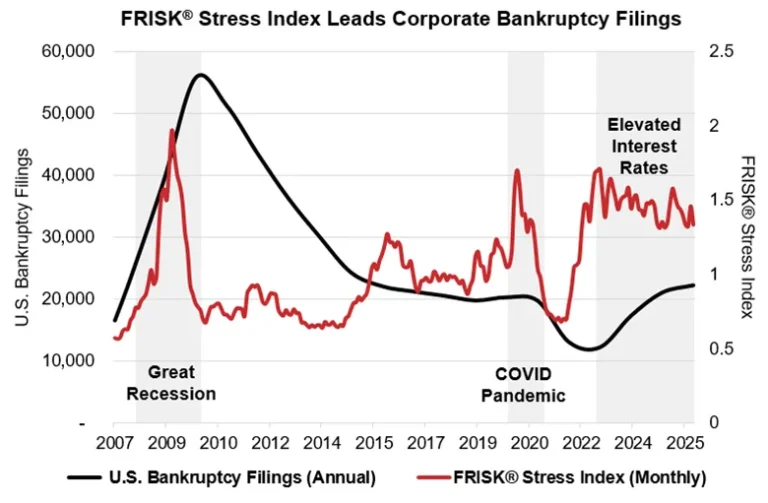
The second feature is around highly accurate, real-time risk score. Payment history alone is backward-looking: it tells a credit and finance teams how a customer has paid in the past, not how that customer will perform going forward. A customer that pays on time can still be financially distressed and at high risk of bankruptcy. Public companies and large private companies should not be evaluated using payment-based scores alone, which frequently leads to the Cloaking Effect: a company paying on time while nonetheless financially distressed. Financial-only scores carry a different limitation, since they are typically updated only quarterly or annually, which can produce the Latency Effect, where the model fails to capture distress accurately or in time to act.
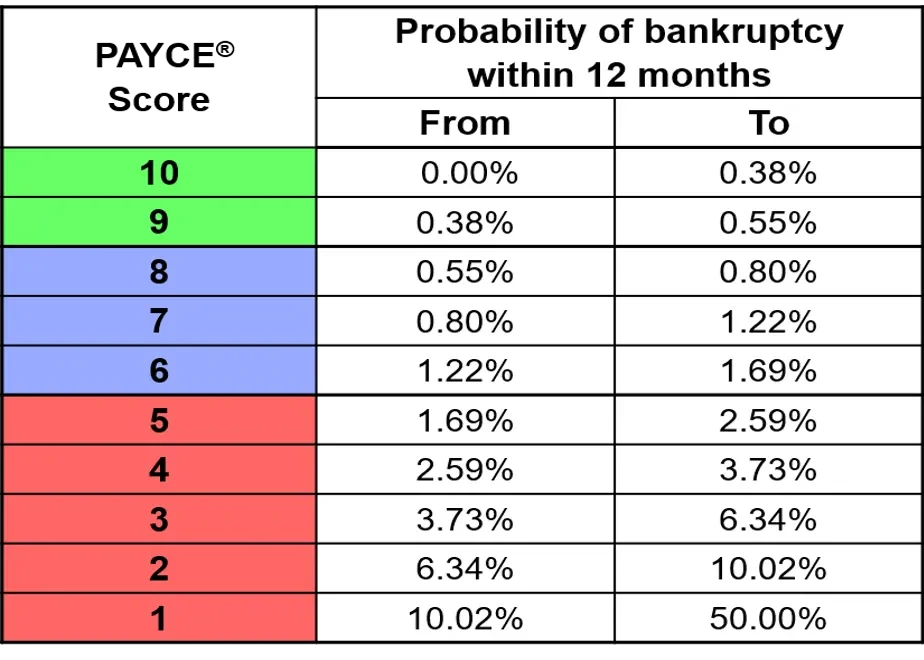
CreditRiskMonitor’s FRISK® Score is 96% accurate at assessing bankruptcy probability over the next 12 months for public companies, while its PAYCE® Score is 80% accurate at the same assessment for private companies. Both scores are AI-driven models built on high-quality, multi-source data rather than a single input, which makes them more predictive than traditional models. These are the bankruptcy risk scales for the FRISK® and PAYCE® Scores.

3. Continuous Portfolio Monitoring and Alerts
Credit risk management software should flag a customer automatically the moment its financial condition changes and/or a material event occurs. Common event triggers include a change in the customer’s risk score or rating, a delayed regulatory filing, going concern flags, warn notices, executive management updates, change in control, litigation, and more.
These can be early indications of a change in a customer’s financial condition, which credit teams can then assess. Depending on the risk level, the alert can trigger a particular process: automatic approval for low-risk companies, investigation for medium risk, and risk mitigation for high risk. Organizations should align this process to their own credit policy, and it’s critical to review and update that process regularly. This is where an organization needs to deploy appropriate workflows that push decisions to the right stakeholders or trigger actions needed to drive risk mitigation (e.g., escalate for special approvals or block orders when circumstances demand).
4. Trade Payment Behavior and Peer Benchmarking
Trade payment data, aggregated information showing how a company pays its other trade creditors and not just how it pays your business, is another important feature. Our Trade Contributor Program securely analyzes your receivables and provides dashboards, reports, and benchmarking tools to improve your risk and collections processes. Understanding your slow payers is among the most important metric for action on individual accounts. Inputs from these trade account comparisons will help set better DSO metrics, as you now have a basis for negotiating better payment.
To get started, see our guide on “How Organizations Benefit from Sharing Trade Receivables Data.”
5. Credit Limits
A credit limit recommendation matters because a limit set in isolation, without knowing what’s typical for a business of that size, sector, and risk profile, tends to run either too conservative on good accounts, or too generous on risky ones. This can be extremely useful if a firm is also insuring its receivables, and there is a need to track insured limits against goals. Credit limits, along with scores, provide a window into growth accounts where low-risk accounts with low balances but high limits are expansion opportunities.
Benchmarking a requested limit against how similar businesses are actually being extended credit gives a credit team a defensible, data-backed starting point. From there, companies can optimize their credit limits to drive profitable growth while minimizing risk exposure.
Proven Benefits of Credit Risk Software
Automating these five features changes how a credit department operates day to day. The benefits fall into three categories: less bad debt, faster decisions, and stronger collections performance.
Reduced Bad Debt Exposure
Automated credit risk monitoring catches deteriorating accounts earlier, giving a credit team time to reduce exposure (lowering a credit limit, requiring prepayment, or pulling terms altogether) before a bad debt actually happens. Industry research on AR automation links automated monitoring and collections to materially lower write-off rates.
CreditRiskMonitor has seen clients reduce their trade exposure, in some cases by 50%, in advance of a customer’s bankruptcy filing, and prevent substantial A/R write-offs to save millions of dollars.
Faster Credit Decisions and Onboarding
Automating financial data pulls and risk scoring cuts approval time, so sales isn’t stuck waiting on a credit decision to close a deal. A team working from real-time data and a pre-built risk score can turn around a decision in a fraction of the time manual review takes, without sacrificing the diligence behind it.
CreditRiskMonitor’s reports provide access to daily updated scores and credit limit ranges, so credit professionals can grant approvals or adjust exposure quickly rather than waiting on a fresh pull. That same data has also been made available inside Nuvo’s credit onboarding tool, which supports a median approval time of 1.1 days, effectively a one-business-day turnaround.
Improved DSO and Collections
The typical approach to collections is to prioritize by dollar size and past-due length alone. Automated risk monitoring flags at-risk accounts early enough for a collections team to prioritize outreach before a balance falls further past due, rather than working every account the same way. Pairing real-time risk scoring with risk-based collections workflows is what drives DSO and recovery-rate gains.
Advanced Analytics for Portfolio Management
Continuous Portfolio Monitoring
Monitoring risk and payment performance daily and weekly, not just at renewal, is what separates a genuinely continuous system from a periodic one. Competing solutions that only refresh risk data quarterly or annually leave a wide window in which a customer’s condition can deteriorate unnoticed, a gap that often ends in a surprise bankruptcy or a sudden run of delinquency. A portfolio-wide view refreshed at that frequency lets a credit department see accounts changing by risk level and understand payment performance before those trends show up as missed payments.
Concentration and Exposure Analysis
Concentration risk shows up when too much receivable exposure sits with too few customers, or too heavily within a single industry or geography. That exposure can be tracked by customer, risk tier (high, medium, and low), industry, and geography, giving credit and collections teams deeper insight into where real risk is concentrated, and giving credit leadership a clearer story to bring to the CFO.
Final Thoughts
The right credit risk management software addresses each of these challenges directly: maximizing coverage on total A/R across both public and private companies, modernizing the credit policy for AI, and making decisions based on accurate, high-quality data. It lowers bad debt exposure, speeds up credit decisions with a documented trail behind each one, and strengthens customer relationships by replacing guesswork with data.
Most credit and collection professionals still rely on multiple tools rather than a single platform. This is where integrating credit reporting, scores, and payment performance into the systems a team already uses drives more effective decisions, reduces error rates, and increases productivity without having to switch between systems.
None of this works without quality, timely data behind it. That same foundation, clean, current data flowing into the platform, is what makes automated workflows possible today. MCP (Model Context Protocol) is another frontier that leading organizations are considering and implementing, connecting that data directly to AI agents to serve the broader organization.
Sources
Administrative Office of the U.S. Courts. Bankruptcies Rise 12.2 Percent. Published July 28, 2026. https://www.uscourts.gov/data-news/judiciary-news/2026/07/28/bankruptcies-rise-122-percent
Nuvo. Automated Credit Decisions: How Credit Teams Move Faster Without Taking on More Risk. Published May 5, 2026. https://nuvo.com/resources/automated-credit-decisions-how-credit-teams-move-faster-without-taking-on-more-risk
CreditRiskMonitor. FRISK® Score Fact Sheet. https://pages.creditriskmonitor.com/hubfs/Fact%20Sheets/Fact_Sheet_FRISK_Score.pdf
CreditRiskMonitor. PAYCE® Score Fact Sheet. https://pages.creditriskmonitor.com/hubfs/Fact%20Sheets/Fact_Sheet_PAYCE_Score.pdf